
Updated Standards
Free Range Standards for Laying Hens
Designed to Support Meaningful Use of Outdoor Space
What’s Changed

Enhanced standards for cover placement and range design.
Additional monitoring, documentation and audit verification.
Enhanced vegetation requirements across the range.
Expanded evaluation of range use and bird distribution.
Additional animal-based welfare indicators (e.g., plumage condition, mortality tracking).
Enhanced outdoor enrichment requirements.
How This Impacts You
For Producers
Clear, measurable requirements help you understand what’s expected, prepare for audits and demonstrate your commitment to animal welfare.
For Retailers & Supply Chain
Enhanced standards provide greater confidence that certified products meet consistent, science-based animal welfare requirements, helping support sourcing decisions and consumer trust. Learn more
For Consumers
These updated standards strengthen how hens experience the outdoors, including how they use outdoor space, express natural behaviors and benefit from enriched environments. Learn more
Want quarterly updates on certification news and standards changes? Sign up for The Barn Brief


New to American Humane Certified™? Start here.
A step-by-step guide to understanding the standards, preparing your operation and beginning the certification process.
Looking to expand or transition your certification?
See how the updated standards compare and where they align with your current program and practices.
Questions? Contact our team using the inquiry form or email us directly.
Resources to Support Implementation
Practical tools to support day-to-day management, animal welfare monitoring and audit readiness.
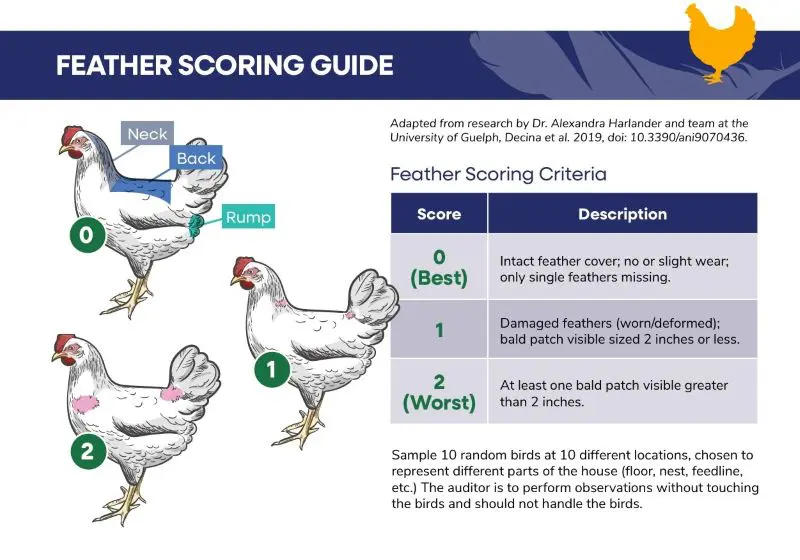
Feather Scorecard
A standardized tool that helps assess plumage condition and track bird welfare.

Outdoor Access Standard Operating Procedure
Provides practical guidance on enrichment, shade placement and managing outdoor access to support natural behavior.
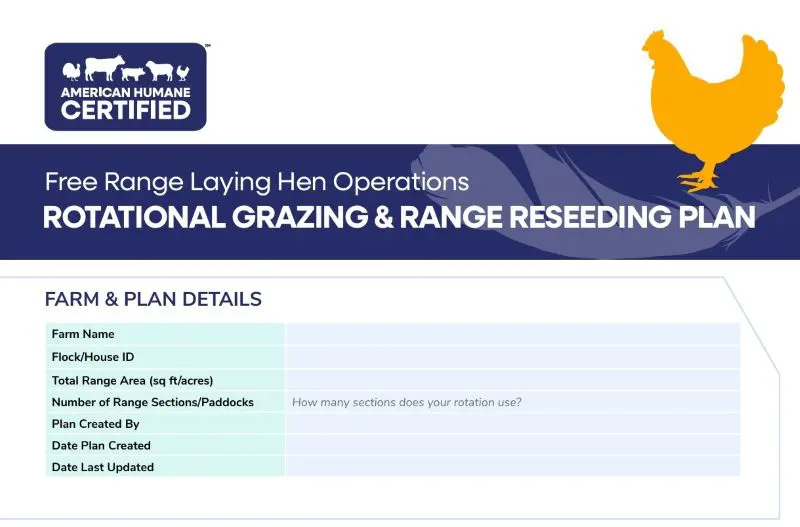
Rotational Grazing and Range Reseeding Plan
Helps manage vegetation, rotation schedules and long-term range health.

Outdoor Enrichment Guide
Low-cost enrichment ideas — perches, shade, dustbathing areas — to draw hens further into the range and improve utilization and compliance.

Why Become American Humane Certified?
As the first and largest third-party farm animal welfare certification in the U.S., the American Humane Certified Farm Program has helped set the standard for ethical farming for more than 25 years, providing a credible way to demonstrate your commitment to animal welfare and build trust with retailers and consumers.
FAQs
Confinement periods required by a state or federal authority are exempt from the 90-day maximum. Documentation of the lockdown and its duration is still required, but those days will not count against your annual total.
We recognize that environmental conditions naturally influence range use on any given day. Auditors are required to record ambient temperature, weather conditions, time of day, and season at the time of the distribution assessment, and scoring for this measure is weighted to account for those contextual factors.
Yes, pursuing multiple certifications simultaneously is possible. We have prepared a detailed gap analysis outlining the additional requirements for producers currently holding USDA Organic or Certified Humane certification. Download the Compare and Prepare checklist.
Plumage scoring must be conducted separately for each house, with a minimum of 100 birds scored indoors and an additional 100 birds scored outdoors per free-range house. Scores from one house cannot be combined with or applied to another.
We understand that some circumstances are beyond a producer’s control. In these situations, a non-conformance will be issued, but the details and documented evidence of the contributing conditions will be taken into account. This audit item is weighted accordingly, and a documented remediation plan will be expected.
Veterinary sign-off is not required. The record must clearly identify the specific cause of the mortality increase and describe the management steps taken in response. The level of detail should be sufficient for an auditor to understand what happened and how it was addressed.
At least two distinct types of enrichment must be present in the outdoor area beyond the first third of the outdoor area closest to the house at the time of the audit. They must represent at least two of the following five categories: structural/perching, shade, dustbathing substrate, or novel/sensory items. All enrichment must be in usable condition. Please refer to the Enrichment Guide for full details on approved enrichment types.
Shade must be provided beyond the first third of the outdoor area closest to the house wall and must be present at a minimum of two distinct distance points — for example, at 10–15 meters and again at 25–40 meters — to create a stepping-stone pattern that encourages birds to move progressively further from the house. Please refer to the Exterior Access Standard Operating Procedures for full details.
Published October 21, 2026